
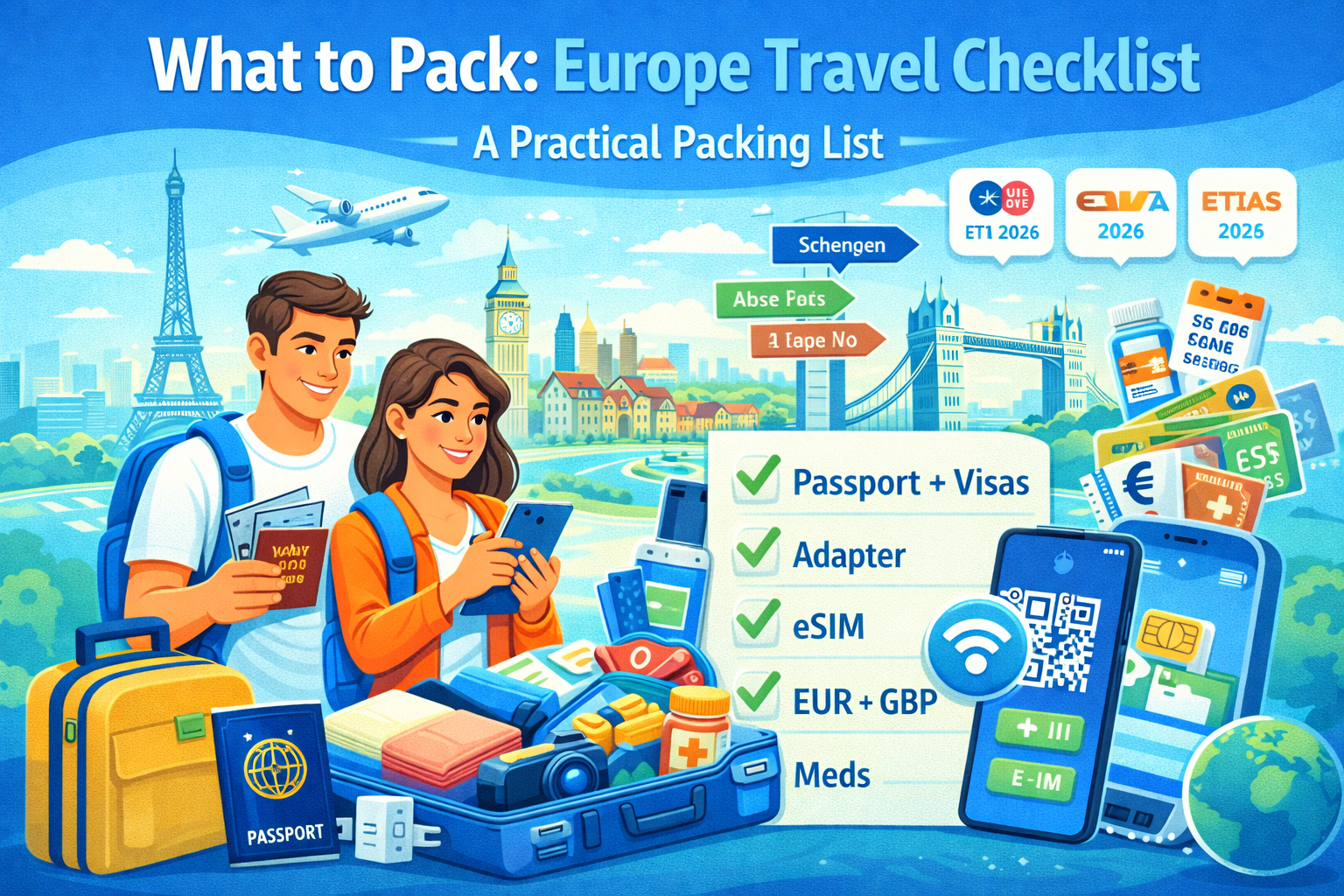
Packing for Europe is easy to overcomplicate because “Europe” isn’t one thing.
A weekend in Paris, a road trip through Italy, and a week in London are all “Europe”… but the rules, plugs, and entry processes are not identical. So this checklist starts with the things that can actually derail a trip (documents + border rules), then moves into the practical stuff (tech, clothes, and the few items people always forget).
Step zero: define your route (Schengen vs UK vs “not quite Schengen”)
Schengen basics you should know
For many non‑EU travelers, Schengen rules matter most:
- visa policy is built around the 90 days in any 180 days rule for short stays
- your passport should be valid for at least 3 months after the date you intend to leave the EU/Schengen, and issued within the last 10 years
New(er) border reality: EES + ETIAS timeline
If you’re traveling visa‑free to Schengen as a non‑EU national, two systems are important:
- EES (Entry/Exit System): the EU’s official site states EES started operating on 12 October 2025, with a progressive rollout and full implementation by 10 April 2026.
- ETIAS: the official ETIAS site states it will start operations in the last quarter of 2026, and that no action is required from travelers yet until the EU announces a specific start date.
Plain-English takeaway: in 2026, expect more border steps (biometric/data collection at some crossings already), and later in the year a new pre‑travel authorization (ETIAS) will become a thing.
If your “Europe” includes the UK
The UK is not in Schengen, and starting 2026 the UK is enforcing advance permission for many visitors:
- UK government announced that from February 2026 visitors will not be able to travel to the UK without advance permission (ETA scheme enforcement).
The checklist (copy/paste friendly)
1) Documents & essentials (don’t leave home without these)
- Passport (check the 3‑month validity after departure + issued within 10 years rule if you’re non‑EU traveling into the EU)
- Any required visa / residence permit
- If applicable in 2026: know whether you’ll be processed under EES (biometric/data collection)
- UK trip: check if you need a UK ETA (enforced from Feb 2026)
- Travel insurance docs (policy number + emergency contacts)
- Digital + printed copies of passport and key bookings (keep copies separate from the original)
2) Money
- 1–2 bank cards (ideally from different networks)
- Small amount of cash in local currency (Europe ≠ only euro; not every country uses EUR)
- Bank travel notices / card app installed
- A simple rule: one “daily wallet” card + one backup card kept elsewhere
3) Tech (this is where “Europe” trips get annoying)
- Phone + charging cable
- Power bank (especially if you rely on maps and tickets)
- Plug adapter
- Plug Type C is widely used across Europe, but not in the UK and Ireland (and also not in Cyprus and Malta).
- The UK uses Type G.
- Optional but useful: a small multi‑port charger (one adapter, one brick, charge everything)
4) Connectivity (don’t gamble on airport Wi‑Fi)
- Travel eSIM (installed before departure)
- QR code stored offline (screenshot + email backup)
- Offline maps for your first city (the moment you land is when you need data the most)
If you’re using eSIM2get:
- install via QR code (iPhone/Android steps are on your install page)
- remember: the bundle starts when the eSIM first connects to a supported network with Data Roaming enabled
5) Clothes (pack for walking, not for photos)
Europe trips are walking trips. Even if you don’t plan them that way, they become that way.
Minimum “works almost anywhere” kit:
- Comfortable walking shoes (the real MVP)
- Light jacket / windbreaker (weather changes fast in many cities)
- 1 “nice” outfit (for restaurants/theatre), the rest: simple layers
- Compact umbrella or packable rain shell (pick one)
Seasonal adds:
- Summer: breathable top layers, sunscreen, hat
- Winter: gloves, scarf, thermal base layer (cities get cold + windy)
6) Health & personal items
- Prescription meds (plus a little buffer)
- Basic travel аптечка: pain reliever, plasters, antiseptic wipes
- Glasses/contacts + spare
- Earplugs + sleep mask (night trains, shared hotels, city noise)
7) Practical extras that people forget
- Small day bag / crossbody (secure + comfortable)
- Refillable water bottle
- A tote bag (groceries, markets, beach days, random purchases)
- Luggage tag + a photo of your suitcase (helps at lost baggage desks)
A quick Europe packing strategy that actually works
If you’re unsure, pack for 3–4 days, not for 14. Most European cities have laundry options, and overpacking punishes you every time you take stairs, trains, and cobblestone streets.