
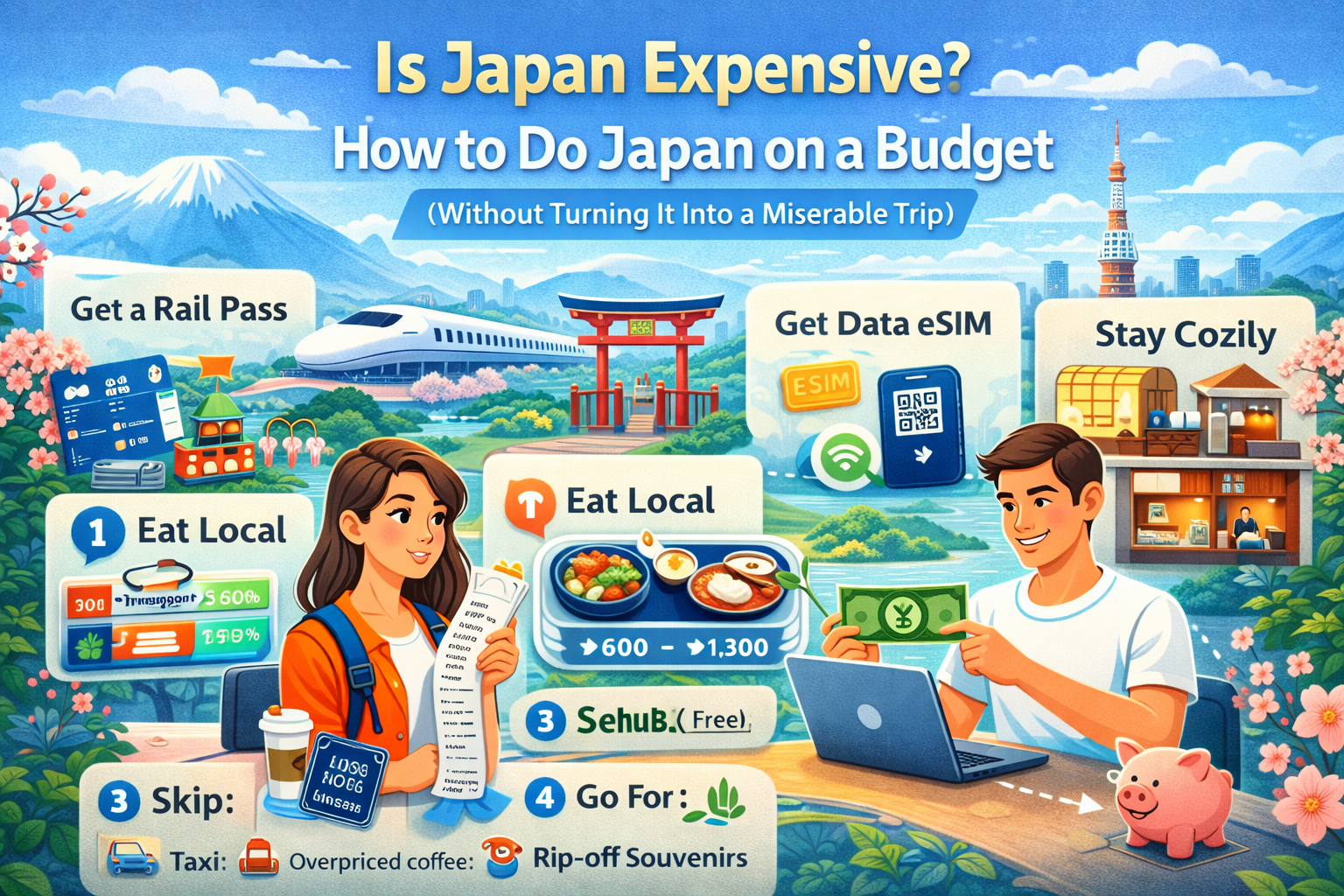
Let’s be honest: Japan can be expensive — but it doesn’t have to be
Japan has a reputation for being pricey, mostly because people remember:
- Shinkansen tickets
- Tokyo hotels
- “I accidentally went to the fancy sushi place” dinners
But Japan’s own tourism guidance points out something important: with advance planning, Japan can be affordable even for budget-conscious travelers, thanks to budget accommodation options and transportation/sightseeing discounts.
So the question isn’t “Is Japan expensive?”
It’s: Which parts of Japan are expensive, and which parts can be surprisingly reasonable?
Where Japan usually does hit your wallet
1) Long-distance transport (especially if you hop cities a lot)
If your plan is Tokyo → Kyoto → Osaka → Hiroshima → back to Tokyo in 7 days… your transport is the big variable.
The official JAPAN RAIL PASS comes in 7/14/21-day options, with different classes (Ordinary vs Green).
Whether it’s worth it depends entirely on your route frequency and distance.
Budget move:
Decide early if you’re doing:
- one “big” Shinkansen hop and then staying put, or
- lots of city-hopping
That choice alone can shift your entire budget.
2) Hotels in the most “obvious” neighborhoods
Staying right in the center is convenient — and often priced accordingly.
Budget move:
Stay 1–3 metro stops out. Tokyo and Osaka public transit makes this surprisingly painless.
Where Japan can be very budget-friendly
1) Food (if you don’t eat every meal in tourist hot spots)
Japan is one of the few countries where you can eat well without constantly spending restaurant money.
- Convenience stores are genuinely decent.
- Lunch sets tend to be cheaper than dinner.
- Supermarkets often discount prepared food in the evening.
2) Sightseeing (many iconic experiences are low-cost or free)
Japan has a lot of “walkable wonder”:
- neighborhoods
- shrines/temples (many are free to enter; some charge for special gardens or halls)
- parks
- viewpoints
Japan’s official budget guide also highlights sightseeing discounts and planning ahead.
Transport: budget strategies that don’t ruin the trip
Use the JR Pass only if it genuinely fits your route
Here are the official reference prices for the nationwide Japan Rail Pass options (Ordinary/Green, 7/14/21 days).
If you’re not doing lots of long-distance JR travel, it can be overkill.
Consider regional passes (often better value)
If you’re staying mainly in one region (Kansai, Kyushu, etc.), regional passes can be better aligned with your itinerary.
Accommodation: where to save without sacrificing sleep
Options that often offer the best value:
- Business hotels (clean, consistent, small rooms but very functional)
- Hostels (private rooms exist, not just dorms)
- Capsule hotels (fun once, maybe not for everyone)
- Guesthouses outside the “center”
A personal tip: don’t underestimate how much money (and sanity) you save by choosing a place that’s close to a station — even if it’s not the “famous” station.
The “I want souvenirs” budget trick
Set a souvenir rule before you shop. Seriously.
Example rules:
- One “nice” item per city
- Everything else must fit in a small pouch
- If it doesn’t fit in your luggage, it doesn’t come home
Staying connected (so you don’t waste money on small mistakes)
Budget travel in Japan is easier when you can:
- check train platforms quickly
- translate menus
- navigate in smaller neighborhoods without panic
Installing an eSIM before departure and switching it on after landing is the simplest workflow.