
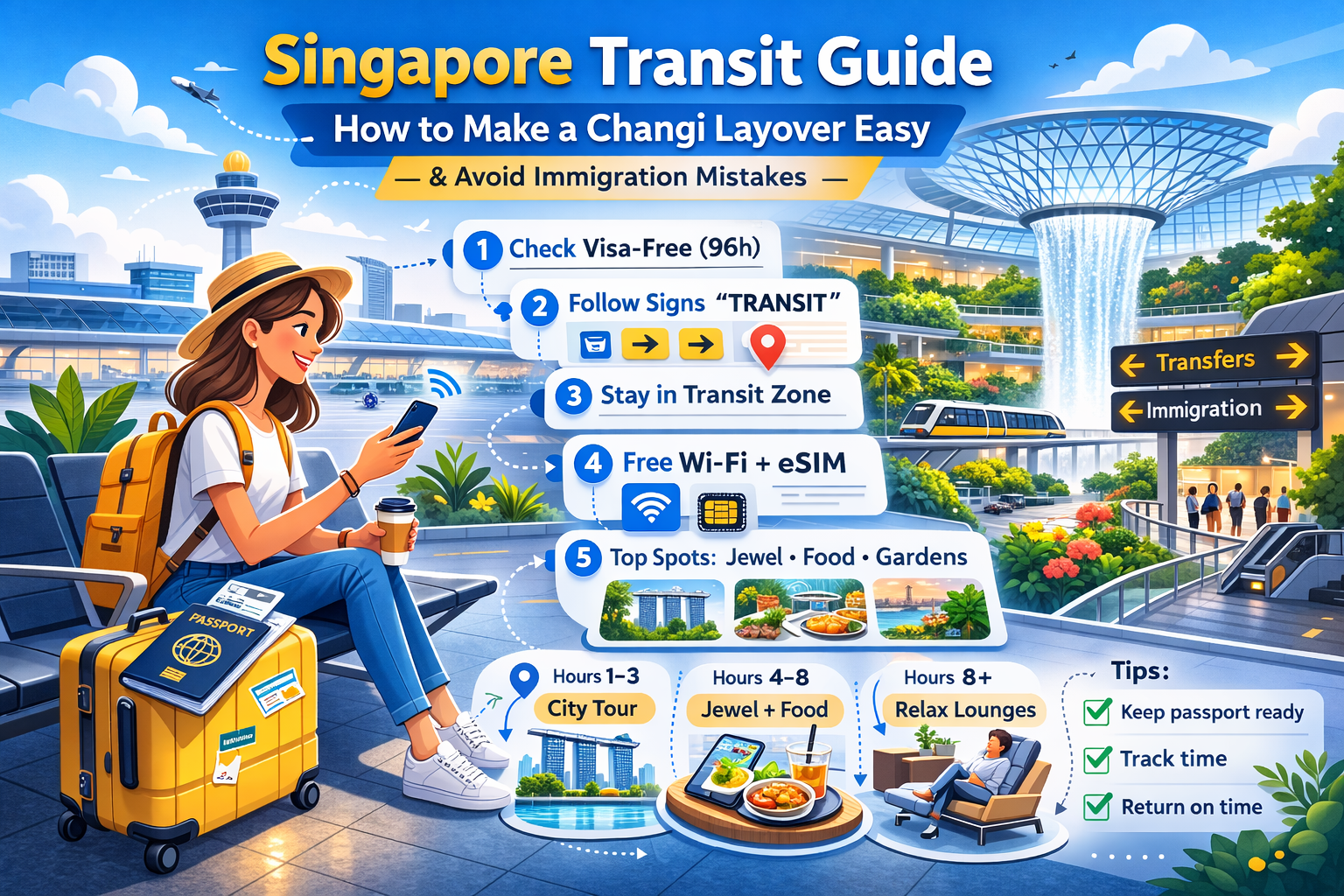
First: what “transit” means in Singapore (in plain English)
Singapore is very clear about what counts as a transit passenger:
You’re a transit traveller if you’re passing through Singapore without clearing arrival immigration.
The moment you clear immigration (for any reason), you’re no longer “just transiting.” You’re entering Singapore, and you must meet entry requirements.
The #1 reason people accidentally have to clear immigration
Two classic situations:
- Your checked baggage isn’t tagged through to your final destination.
- Your connection requires you to collect tickets/baggage and check in again.
ICA even warns that some Low Cost Carriers require passengers to clear immigration to collect onward tickets in the departure check-in hall.
Changi’s own transit guide repeats the same point.
Practical rule:
If your flights aren’t on one itinerary (or you’re mixing low-cost carriers), assume you might need to enter Singapore — and check with your airline before you fly.
Do you need an SG Arrival Card if you’re “only transiting”?
Not always.
Singapore requires SG Arrival Card submission within three days (including day of arrival) for travellers arriving in Singapore — except those transiting/transferring without seeking immigration clearance.
So:
- Staying airside (no immigration)? SG Arrival Card is not required.
- Leaving the airport / entering Singapore? You generally need to submit it.
Do you need a visa for a layover in Singapore?
If you remain in the transit area and don’t clear immigration, you typically don’t need an entry visa — because you’re not entering Singapore.
If you want to enter Singapore during your layover, visa rules apply. Some travellers may qualify for the Visa Free Transit Facility (VFTF) (up to 96 hours) if they meet the criteria — and entry is assessed by ICA officers at the point of entry.
Also worth noting: visa-required travellers are explicitly pointed to visa/VFTF options on the official “Entering Singapore” page.
How much time do you actually need at Changi?
For a smooth connection, I personally treat these as the “don’t gamble” ranges:
- < 90 minutes: stay sharp, don’t wander, go straight to your next gate.
- 90–120 minutes: manageable for most connections if everything is tagged through.
- 3+ hours: you can actually enjoy the airport.
A lot of guides recommend at least 1.5–2 hours for a safe transfer window.
What to do on a Changi layover (based on how much time you have)
If you have 1–2 hours
- Follow signs to your gate and clear any required security screening.
- Get your basics done: water, restroom, charge devices.
If you have 2–6 hours
This is the sweet spot where Changi is genuinely enjoyable.
Changi’s transit guide lists options like transit hotels, lounges, rest areas, showers/spa services, and attractions — plus access to Jewel.
If you have 6+ hours
Consider:
- Free Singapore Tour (if it fits your schedule and eligibility).
- Or entering Singapore for a quick city visit (only if you’re sure you meet entry rules and have time buffer).
How to avoid the “no internet, no clue” arrival moment
Even if you’re only transiting, having data helps for:
- Flight changes
- Gate updates
- Map/navigation inside the terminals
- Messaging your hotel/host
Tip: install your eSIM before departure on Wi‑Fi, then switch it on when you land. eSIM2get plans are designed so you can install early without accidentally starting the bundle if you don’t connect to the network with Data Roaming enabled.
Quick FAQ
Am I a transit passenger if I need to collect baggage?
No. If you have to clear immigration to collect baggage/tickets and re-check in, you’re not a transit traveller.
Do I need SG Arrival Card for transit?
Not if you’re transiting without immigration clearance.
Can I get 96-hour visa-free transit in Singapore?
Some travellers may qualify for the 96-hour VFTF if they meet ICA’s criteria; entry is assessed by ICA officers.